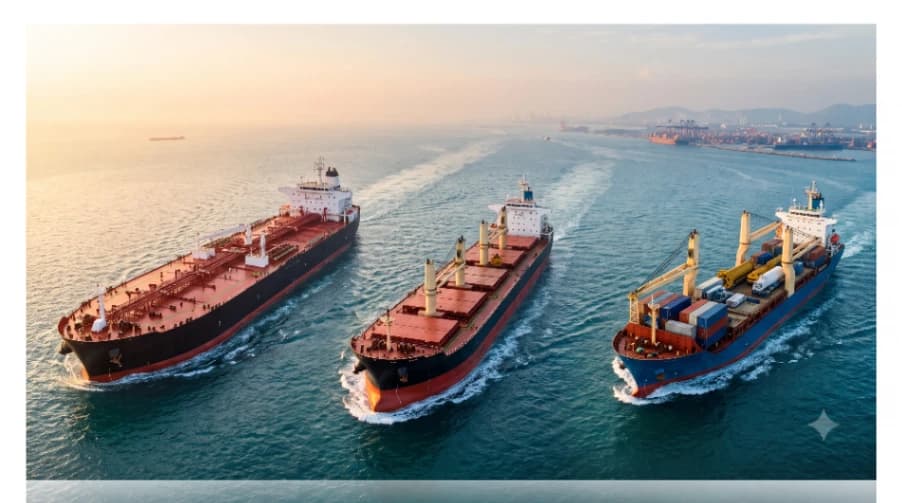
Tankers, Bulk Carriers, or MPVs: Which Vessel Type Makes Financial Sense in 2026?
If you're in the market to buy or charter a vessel in 2026, you're making that decision in one of the most consequential shipping cycles in over a decade. Geopolitical disruptions, new commodity trade routes, and the energy transition are reshaping earnings across every segment — and not equally.
The three vessel types most commonly traded on ShipMarketSquare — tankers, bulk carriers, and multipurpose vessels (MPVs) — are each telling a very different story this year. Before you commit capital, here's what the data says.
Tankers: The Market Running Hottest
If pure earnings performance is your benchmark, the tanker market is hard to ignore right now.
VLCC (Very Large Crude Carrier) earnings peaked above $100,000 per day by late 2025 — more than 60% above the 10-year average — and have held firm into 2026. The drivers behind this strength are structural, not seasonal: sanctions on Russian and Iranian crude have pulled a significant share of the global VLCC fleet into a "dark fleet" operating outside normal commercial channels, tightening effective vessel supply for compliant owners. At the same time, longer voyage distances — crude traveling from the Middle East Gulf and Atlantic Basin to Asian buyers — have extended tonne-mile demand, effectively multiplying the work each ship has to do.
OPEC+ production increases have added cargo volume, and floating storage dynamics have absorbed additional capacity. The result is a freight market that DNV analysts describe as having "strong fundamentals" underpinned by resilient oil demand, shifting trade patterns, and a tighter-than-expected supply picture.
That said, tankers are not without risk. Fleet deliveries are expected to nearly double in 2026, with around 40 new VLCCs scheduled to hit the water. The key question for prospective buyers is whether tonne-mile demand — driven by continued trade route inefficiencies — will absorb that new tonnage before it deflates rates. The early signs are encouraging: geopolitical complexity is not unwinding quickly, and the sanctions-induced tightening of the compliant fleet appears durable for the near term.
Who should be looking at tankers? Investors with access to capital who can absorb the higher acquisition cost of a modern crude or product tanker, and who have charterer relationships or the ability to operate in the spot market. The earnings window is open — but you want to be positioned before the fleet expansion bites.
Bulk Carriers: The Structural Play
The dry bulk sector is delivering a more nuanced story in 2026, and for patient investors, it may be the most interesting medium-term opportunity in the market.
The Baltic Dry Index hit a 19-month high in late 2025 and has remained constructive in 2026, supported by a pair of structural developments that are reshaping long-haul iron ore trade. Guinea's Simandou iron ore project — one of the largest untapped deposits in the world — began commercial shipments in late 2025 and is now ramping up. By full production, analysts estimate the mine will generate approximately 120 million tonnes of iron ore per year, requiring around 180 Capesize vessels on long-haul Guinea-to-China round trips. These voyages are roughly 90+ days versus the shorter Pilbara-to-China route — meaning each Simandou cargo requires nearly three times the vessel capacity per tonne. When the Simandou ramp-up is complete, analysts project the mine alone will add around 10% to global iron ore tonne-miles and approximately 3.5% to total dry-bulk tonne-miles.
In the first quarter of 2026, dry-bulk ton-miles increased 5.2% year-on-year — stronger than anticipated for what is typically the weakest quarter of the year. Australian iron ore shipments rose over 4% and Brazilian exports recovered solidly, absorbing much of the fleet expansion scheduled for 2026.
Near-term, the picture is more volatile for mid-size vessels. Panamax earnings face pressure from fleet growth and moderating coal demand. But for Capesize and Newcastlemax tonnage, the structural trajectory is increasingly compelling. As Simandou scales toward 60 million tonnes by 2028 and 120 million tonnes by 2029-2030, demand for large bulk carriers is set to grow substantially — and the current orderbook does not match it.
Who should be looking at bulk carriers? Owners seeking a medium-to-long horizon play with structural demand tailwinds. Capesize vessels are the standout, but even in the general cargo and Supramax space, the global energy transition is generating demand for minor bulks — materials like copper, lithium, and construction aggregates — that support a broadly healthy market.
Multipurpose Vessels: The Versatility Premium
Multipurpose vessels occupy a different investment logic entirely. Where tankers and bulk carriers are commodity plays driven by freight rates and tonne-mile economics, MPVs are capability plays — and in 2026, capability is in demand.
The MPV market is set to fracture along a clear fault line this year. Project carriers — those serving energy infrastructure, offshore wind, and heavy-lift cargo — are positioned for rate increases driven by surging energy sector investment. General cargo MPVs, by contrast, face headwinds from the container market, which has seen significant overcapacity and softer rates.
The growth story for the right type of MPV is compelling. The global MPSV (multipurpose support vessel) market was valued at approximately $4.79 billion in 2026 and is projected to reach $6.26 billion by 2030 — a CAGR of nearly 7%. The main drivers: offshore oil and gas activity, the rapid buildout of offshore wind infrastructure, subsea operations, and marine survey work. Oil and gas currently accounts for around 66% of MPSV demand; the renewable energy sector accounts for the remaining 34% and is growing fastest.
For owners with the right vessel — particularly those with dynamic positioning capability, crane capacity, or deck versatility suitable for project cargo — the earnings environment is strong and the demand pipeline visible. Offshore wind installation and maintenance is a multi-decade capital commitment by governments across Europe and Asia-Pacific, and it requires exactly the kind of specialist support vessels that a well-specified MPV provides.
The caveat: general cargo MPVs competing directly with container shipping face a tougher road. The fragile easing of Red Sea disruptions is gradually pulling container traffic back toward the Suez Canal, reducing the demand uplift that had supported breakbulk and general cargo carriers.
Who should be looking at MPVs? Owners able to position their vessel in the project cargo or offshore energy space — ideally with DP2 or DP3 capability. The general cargo variant is a more difficult play for 2026. If you're looking at MPVs on ShipMarketSquare, examine the spec sheet carefully: the sector rewards versatility pointed in the right direction.

The Bottom Line
There is no single right answer here — which is the point. The vessel that makes financial sense in 2026 depends on your capital position, time horizon, operational capabilities, and charterer relationships.
Tankers are performing now. If you have the capital and the market access, the earnings environment rewards action. Bulk carriers — particularly large ones — offer a compelling structural argument, but patience is required as Simandou ramps and the fleet picture clarifies. MPVs reward specificity: a well-specified project carrier pointed at the energy sector is in a structurally growing market; a general cargo vessel competing with containers is not.
What all three have in common is that 2026 is a year where informed buyers will separate themselves from those reacting to headlines. The ShipMarketSquare platform lists vessels across all three categories — if you know what you're looking for, the opportunity to buy or charter smart is there.
Browse current tanker, bulk carrier, and multipurpose vessel listings at ShipMarketSquare.com. New listings reviewed and approved daily.
If you're in the market to buy or charter a vessel in 2026, you're making that decision in one of the most consequential shipping cycles in over a decade. Geopolitical disruptions, new commodity trade routes, and the energy transition are reshaping earnings across every segment — and not equally.
The three vessel types most commonly traded on ShipMarketSquare — tankers, bulk carriers, and multipurpose vessels (MPVs) — are each telling a very different story this year. Before you commit capital, here's what the data says.
Tankers: The Market Running Hottest
If pure earnings performance is your benchmark, the tanker market is hard to ignore right now.
VLCC (Very Large Crude Carrier) earnings peaked above $100,000 per day by late 2025 — more than 60% above the 10-year average — and have held firm into 2026. The drivers behind this strength are structural, not seasonal: sanctions on Russian and Iranian crude have pulled a significant share of the global VLCC fleet into a "dark fleet" operating outside normal commercial channels, tightening effective vessel supply for compliant owners. At the same time, longer voyage distances — crude traveling from the Middle East Gulf and Atlantic Basin to Asian buyers — have extended tonne-mile demand, effectively multiplying the work each ship has to do.
OPEC+ production increases have added cargo volume, and floating storage dynamics have absorbed additional capacity. The result is a freight market that DNV analysts describe as having "strong fundamentals" underpinned by resilient oil demand, shifting trade patterns, and a tighter-than-expected supply picture.
That said, tankers are not without risk. Fleet deliveries are expected to nearly double in 2026, with around 40 new VLCCs scheduled to hit the water. The key question for prospective buyers is whether tonne-mile demand — driven by continued trade route inefficiencies — will absorb that new tonnage before it deflates rates. The early signs are encouraging: geopolitical complexity is not unwinding quickly, and the sanctions-induced tightening of the compliant fleet appears durable for the near term.
Who should be looking at tankers? Investors with access to capital who can absorb the higher acquisition cost of a modern crude or product tanker, and who have charterer relationships or the ability to operate in the spot market. The earnings window is open — but you want to be positioned before the fleet expansion bites.
Bulk Carriers: The Structural Play
The dry bulk sector is delivering a more nuanced story in 2026, and for patient investors, it may be the most interesting medium-term opportunity in the market.
The Baltic Dry Index hit a 19-month high in late 2025 and has remained constructive in 2026, supported by a pair of structural developments that are reshaping long-haul iron ore trade. Guinea's Simandou iron ore project — one of the largest untapped deposits in the world — began commercial shipments in late 2025 and is now ramping up. By full production, analysts estimate the mine will generate approximately 120 million tonnes of iron ore per year, requiring around 180 Capesize vessels on long-haul Guinea-to-China round trips. These voyages are roughly 90+ days versus the shorter Pilbara-to-China route — meaning each Simandou cargo requires nearly three times the vessel capacity per tonne. When the Simandou ramp-up is complete, analysts project the mine alone will add around 10% to global iron ore tonne-miles and approximately 3.5% to total dry-bulk tonne-miles.
In the first quarter of 2026, dry-bulk ton-miles increased 5.2% year-on-year — stronger than anticipated for what is typically the weakest quarter of the year. Australian iron ore shipments rose over 4% and Brazilian exports recovered solidly, absorbing much of the fleet expansion scheduled for 2026.
Near-term, the picture is more volatile for mid-size vessels. Panamax earnings face pressure from fleet growth and moderating coal demand. But for Capesize and Newcastlemax tonnage, the structural trajectory is increasingly compelling. As Simandou scales toward 60 million tonnes by 2028 and 120 million tonnes by 2029-2030, demand for large bulk carriers is set to grow substantially — and the current orderbook does not match it.
Who should be looking at bulk carriers? Owners seeking a medium-to-long horizon play with structural demand tailwinds. Capesize vessels are the standout, but even in the general cargo and Supramax space, the global energy transition is generating demand for minor bulks — materials like copper, lithium, and construction aggregates — that support a broadly healthy market.
Multipurpose Vessels: The Versatility Premium
Multipurpose vessels occupy a different investment logic entirely. Where tankers and bulk carriers are commodity plays driven by freight rates and tonne-mile economics, MPVs are capability plays — and in 2026, capability is in demand.
The MPV market is set to fracture along a clear fault line this year. Project carriers — those serving energy infrastructure, offshore wind, and heavy-lift cargo — are positioned for rate increases driven by surging energy sector investment. General cargo MPVs, by contrast, face headwinds from the container market, which has seen significant overcapacity and softer rates.
The growth story for the right type of MPV is compelling. The global MPSV (multipurpose support vessel) market was valued at approximately $4.79 billion in 2026 and is projected to reach $6.26 billion by 2030 — a CAGR of nearly 7%. The main drivers: offshore oil and gas activity, the rapid buildout of offshore wind infrastructure, subsea operations, and marine survey work. Oil and gas currently accounts for around 66% of MPSV demand; the renewable energy sector accounts for the remaining 34% and is growing fastest.
For owners with the right vessel — particularly those with dynamic positioning capability, crane capacity, or deck versatility suitable for project cargo — the earnings environment is strong and the demand pipeline visible. Offshore wind installation and maintenance is a multi-decade capital commitment by governments across Europe and Asia-Pacific, and it requires exactly the kind of specialist support vessels that a well-specified MPV provides.
The caveat: general cargo MPVs competing directly with container shipping face a tougher road. The fragile easing of Red Sea disruptions is gradually pulling container traffic back toward the Suez Canal, reducing the demand uplift that had supported breakbulk and general cargo carriers.
Who should be looking at MPVs? Owners able to position their vessel in the project cargo or offshore energy space — ideally with DP2 or DP3 capability. The general cargo variant is a more difficult play for 2026. If you're looking at MPVs on ShipMarketSquare, examine the spec sheet carefully: the sector rewards versatility pointed in the right direction.
The Bottom Line
There is no single right answer here — which is the point. The vessel that makes financial sense in 2026 depends on your capital position, time horizon, operational capabilities, and charterer relationships.
Tankers are performing now. If you have the capital and the market access, the earnings environment rewards action. Bulk carriers — particularly large ones — offer a compelling structural argument, but patience is required as Simandou ramps and the fleet picture clarifies. MPVs reward specificity: a well-specified project carrier pointed at the energy sector is in a structurally growing market; a general cargo vessel competing with containers is not.
What all three have in common is that 2026 is a year where informed buyers will separate themselves from those reacting to headlines. The ShipMarketSquare platform lists vessels across all three categories — if you know what you're looking for, the opportunity to buy or charter smart is there.
Browse current tanker, bulk carrier, and multipurpose vessel listings at ShipMarketSquare.com. New listings reviewed and approved daily.