Stop Filling Forms by Hand: How ShipMarketSquare's Smart IMO Lookup Gets Your Vessel Listed in Minutes
Anyone who has ever listed a commercial vessel for sale knows the friction that comes before the listing even goes live.
You sit down with the intention of getting your vessel on the market quickly. Then the form starts asking questions. Gross tonnage. DWT. LOA. Beam. Draft. Main engine make and model. Year built. Class society. Flag state. By the time you've tracked down your ship's particulars document, cross-referenced your class certificate, and typed out fourteen fields of technical data — some of which you had to look up twice because the first entry had a typo — what should have taken ten minutes has eaten an hour. And you haven't even added photos yet.
This is a solved problem. ShipMarketSquare's Smart IMO Lookup exists precisely so you don't have to do any of it manually.
What Is an IMO Number — and Why Does It Unlock Everything?
Every qualifying commercial vessel in the world carries an IMO number: a permanent, seven-digit identifier assigned by the International Maritime Organization and managed on its behalf by S&P Global Market Intelligence. The IMO number was introduced in 1987 under SOLAS regulations to enhance maritime safety and reduce fraud. Its defining characteristic — the feature that makes it so powerful — is that it never changes.
A vessel can be sold five times, renamed three times, re-flagged twice, and transferred between operators across different continents. The IMO number stays the same from the day it's assigned until the ship is scrapped. Every certificate, every registry record, every classification document, every port state control inspection is indexed to that number. It is the single most stable identity a vessel has.
What that means in practice is this: if you know a vessel's IMO number, you know the vessel. Every piece of data attached to it — technical specifications, dimensions, engine details, build year, flag state, class society, ownership history — is retrievable from maritime databases that have been building and maintaining these records for decades. Platforms like MarineTraffic hold data on over 550,000 active and decommissioned vessels, indexed to their IMO numbers and updated continuously. VesselFinder's Vessel Particulars API returns comprehensive technical details for any vessel by IMO number in seconds.
ShipMarketSquare connects directly to these data sources. The result is a listing experience that starts with one field — your IMO number — and does the rest.
How Smart IMO Lookup Works
The process is designed to be as simple as it sounds.
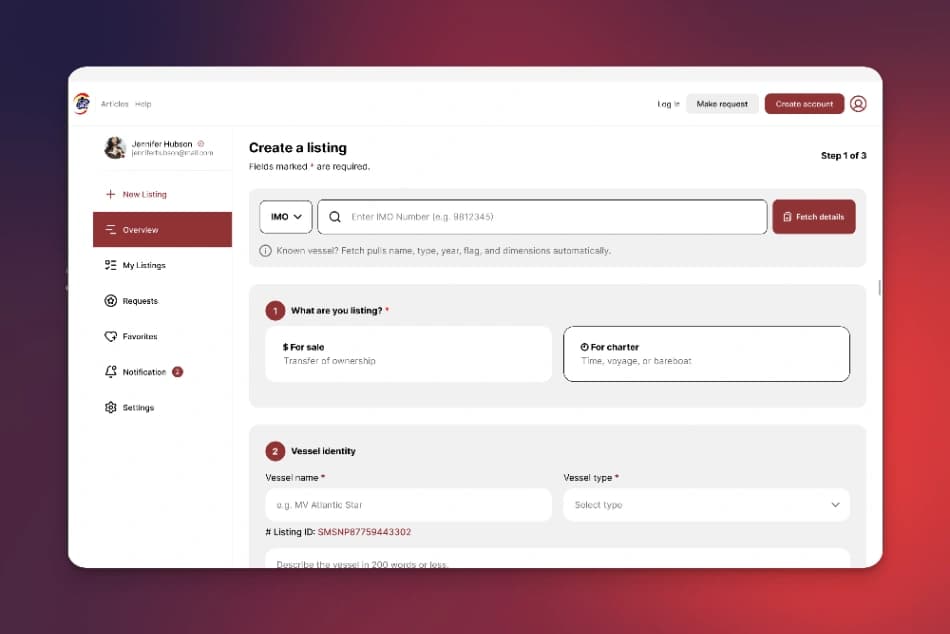
When you begin a new vessel listing on ShipMarketSquare, you'll see the Smart IMO Lookup field at the top of the submission form. Enter your vessel's seven-digit IMO number and hit search. Within seconds, the platform queries maritime data registries and returns your vessel's verified technical profile. The fields that would otherwise require you to manually source and type each value — vessel name, vessel type, gross tonnage, deadweight tonnage, length overall, beam, draft, year built, flag state, class society, main engine details, and more — are populated automatically, pulled directly from the authoritative records attached to that IMO number.
You review the pre-filled data, make any additions specific to your listing (current trading status, asking price, reason for sale, recent maintenance), and proceed to submission.
The most common question sellers ask at this point: what if some of the data is slightly different from my current records? This is worth addressing directly. IMO-linked databases reflect the vessel's registered particulars as maintained in maritime data systems. If your vessel has had changes — a re-flag, a conversion, updated equipment — and those changes haven't propagated to the registry yet, the Smart IMO Lookup will surface the last confirmed record. You can manually update any field before submitting. The pre-fill is a starting point that eliminates the majority of the data entry work; it doesn't override your judgment about your own vessel.
Vessel Photos — Fetched Automatically
The second half of the Smart IMO Lookup goes beyond specifications.
Photos are one of the most time-consuming parts of any vessel listing, and for sellers who don't have a library of recent images readily accessible, they're often the reason a listing gets delayed or submitted with inadequate visual content. The platform addresses this directly.
When you enter your IMO number, Smart IMO Lookup doesn't just retrieve technical data — it also fetches existing photographs of your vessel from maritime photo databases, where user-contributed imagery indexed to IMO numbers is available for hundreds of thousands of ships. These images are surfaced directly in your listing workflow. You can review what's available, select the photos you want to include, and supplement them with your own uploads if you have more recent or higher-quality images available.
For sellers whose vessel has been photographed at port calls, anchorages, or in transit over the years — which most commercial vessels have — this means that even without preparing a dedicated photo set before listing, you can submit a visually complete listing from day one. For sellers who do have their own photos, the fetched images serve as a solid baseline to supplement.
The practical impact: listings submitted through Smart IMO Lookup consistently launch with stronger photo coverage than those entered manually, because the friction of sourcing images is removed from the process entirely.
Why This Matters: The Cost of Manual Data Entry in Maritime
The manual data entry problem isn't trivial in this industry. Research from maritime technology firms has found that manual data entry can account for up to 40% of an operator's administrative time — and that the data quality issues it creates don't just slow people down, they create downstream risk. A typo in a DWT figure or an incorrect class society reference on a vessel listing doesn't just look unprofessional. It causes buyers to second-guess the entire submission and, in some cases, to skip the listing entirely.
The commercial vessel market runs on precision. Buyers making seven- or eight-figure acquisition decisions are working from the specifications in your listing to assess operational fit, financing eligibility, insurance terms, and trading suitability. When those specifications are wrong — even by a small margin — it creates friction at every subsequent stage of the transaction. When they're pulled directly from verified maritime registries, that friction disappears before it starts.
Smart IMO Lookup removes the two biggest sources of listing error: human transcription mistakes and information asymmetry between what a seller remembers and what the official records show. The data that populates your listing is the same data a prospective buyer's broker would verify against during due diligence. Starting from the same source eliminates the gap.
Getting Listed Faster Means Getting to Market Faster
In a shipping market as active as 2026's — with tanker earnings at multi-year highs, bulk carrier demand building momentum from new Atlantic iron ore sources, and MPV project cargo rates rising on the back of offshore energy investment — time on market matters. A listing that takes two hours to prepare and submit manually is a listing that could have been live and in front of buyers two hours earlier.
Smart IMO Lookup is designed to reduce the listing process from something that requires document hunting and careful data transcription to something closer to a single lookup and a review. For sellers with multiple vessels to list, the time savings compound quickly. For sellers working across time zones, dealing with vessel managers, brokers, and administrators on different schedules, removing the manual data dependency simplifies coordination significantly.
The goal is simple: your vessel should be on the market as fast as you decide to put it there. Not as fast as you can locate your ship's particulars document and type out fourteen fields without errors.
How to Use It
If your vessel is already registered with an IMO number — which any qualifying commercial vessel will be — you're ready to use Smart IMO Lookup right now.
Step 1: Create a free account on ShipMarketSquare at shipmarketsquare.com
Step 2: Begin a new vessel listing and enter your IMO number into the Smart IMO Lookup field
Step 3: Review the auto-populated technical specifications and select from the fetched vessel photos
Step 4: Add your listing-specific details: asking price, current status, recent maintenance, delivery terms
Step 5: Submit for review — listings are approved and go live with email notification, typically within one business day
The platform supports both sale and charter listings. If your vessel is available under both terms, you can indicate this during submission and expand your qualified buyer pool without creating a separate listing.
One Number. Your Vessel, Ready to List.
Maritime professionals spend enough time on paperwork. The listing process on ShipMarketSquare is designed to be the one part of a vessel sale that doesn't add to that burden.
Enter your IMO number. Review what comes back. Add what only you know. Submit.
Your vessel — with accurate specifications and real photographs — could be in front of buyers today.
List your vessel for sale or charter at ShipMarketSquare.com. Ships and spares, all in one place.
Anyone who has ever listed a commercial vessel for sale knows the friction that comes before the listing even goes live.
You sit down with the intention of getting your vessel on the market quickly. Then the form starts asking questions. Gross tonnage. DWT. LOA. Beam. Draft. Main engine make and model. Year built. Class society. Flag state. By the time you've tracked down your ship's particulars document, cross-referenced your class certificate, and typed out fourteen fields of technical data — some of which you had to look up twice because the first entry had a typo — what should have taken ten minutes has eaten an hour. And you haven't even added photos yet.
This is a solved problem. ShipMarketSquare's Smart IMO Lookup exists precisely so you don't have to do any of it manually.
What Is an IMO Number — and Why Does It Unlock Everything?
Every qualifying commercial vessel in the world carries an IMO number: a permanent, seven-digit identifier assigned by the International Maritime Organization and managed on its behalf by S&P Global Market Intelligence. The IMO number was introduced in 1987 under SOLAS regulations to enhance maritime safety and reduce fraud. Its defining characteristic — the feature that makes it so powerful — is that it never changes.
A vessel can be sold five times, renamed three times, re-flagged twice, and transferred between operators across different continents. The IMO number stays the same from the day it's assigned until the ship is scrapped. Every certificate, every registry record, every classification document, every port state control inspection is indexed to that number. It is the single most stable identity a vessel has.
What that means in practice is this: if you know a vessel's IMO number, you know the vessel. Every piece of data attached to it — technical specifications, dimensions, engine details, build year, flag state, class society, ownership history — is retrievable from maritime databases that have been building and maintaining these records for decades. Platforms like MarineTraffic hold data on over 550,000 active and decommissioned vessels, indexed to their IMO numbers and updated continuously. VesselFinder's Vessel Particulars API returns comprehensive technical details for any vessel by IMO number in seconds.
ShipMarketSquare connects directly to these data sources. The result is a listing experience that starts with one field — your IMO number — and does the rest.
How Smart IMO Lookup Works
The process is designed to be as simple as it sounds.
When you begin a new vessel listing on ShipMarketSquare, you'll see the Smart IMO Lookup field at the top of the submission form. Enter your vessel's seven-digit IMO number and hit search. Within seconds, the platform queries maritime data registries and returns your vessel's verified technical profile. The fields that would otherwise require you to manually source and type each value — vessel name, vessel type, gross tonnage, deadweight tonnage, length overall, beam, draft, year built, flag state, class society, main engine details, and more — are populated automatically, pulled directly from the authoritative records attached to that IMO number.
You review the pre-filled data, make any additions specific to your listing (current trading status, asking price, reason for sale, recent maintenance), and proceed to submission.
The most common question sellers ask at this point: what if some of the data is slightly different from my current records? This is worth addressing directly. IMO-linked databases reflect the vessel's registered particulars as maintained in maritime data systems. If your vessel has had changes — a re-flag, a conversion, updated equipment — and those changes haven't propagated to the registry yet, the Smart IMO Lookup will surface the last confirmed record. You can manually update any field before submitting. The pre-fill is a starting point that eliminates the majority of the data entry work; it doesn't override your judgment about your own vessel.
Vessel Photos — Fetched Automatically
The second half of the Smart IMO Lookup goes beyond specifications.
Photos are one of the most time-consuming parts of any vessel listing, and for sellers who don't have a library of recent images readily accessible, they're often the reason a listing gets delayed or submitted with inadequate visual content. The platform addresses this directly.
When you enter your IMO number, Smart IMO Lookup doesn't just retrieve technical data — it also fetches existing photographs of your vessel from maritime photo databases, where user-contributed imagery indexed to IMO numbers is available for hundreds of thousands of ships. These images are surfaced directly in your listing workflow. You can review what's available, select the photos you want to include, and supplement them with your own uploads if you have more recent or higher-quality images available.
For sellers whose vessel has been photographed at port calls, anchorages, or in transit over the years — which most commercial vessels have — this means that even without preparing a dedicated photo set before listing, you can submit a visually complete listing from day one. For sellers who do have their own photos, the fetched images serve as a solid baseline to supplement.
The practical impact: listings submitted through Smart IMO Lookup consistently launch with stronger photo coverage than those entered manually, because the friction of sourcing images is removed from the process entirely.
Why This Matters: The Cost of Manual Data Entry in Maritime
The manual data entry problem isn't trivial in this industry. Research from maritime technology firms has found that manual data entry can account for up to 40% of an operator's administrative time — and that the data quality issues it creates don't just slow people down, they create downstream risk. A typo in a DWT figure or an incorrect class society reference on a vessel listing doesn't just look unprofessional. It causes buyers to second-guess the entire submission and, in some cases, to skip the listing entirely.
The commercial vessel market runs on precision. Buyers making seven- or eight-figure acquisition decisions are working from the specifications in your listing to assess operational fit, financing eligibility, insurance terms, and trading suitability. When those specifications are wrong — even by a small margin — it creates friction at every subsequent stage of the transaction. When they're pulled directly from verified maritime registries, that friction disappears before it starts.
Smart IMO Lookup removes the two biggest sources of listing error: human transcription mistakes and information asymmetry between what a seller remembers and what the official records show. The data that populates your listing is the same data a prospective buyer's broker would verify against during due diligence. Starting from the same source eliminates the gap.
Getting Listed Faster Means Getting to Market Faster
In a shipping market as active as 2026's — with tanker earnings at multi-year highs, bulk carrier demand building momentum from new Atlantic iron ore sources, and MPV project cargo rates rising on the back of offshore energy investment — time on market matters. A listing that takes two hours to prepare and submit manually is a listing that could have been live and in front of buyers two hours earlier.
Smart IMO Lookup is designed to reduce the listing process from something that requires document hunting and careful data transcription to something closer to a single lookup and a review. For sellers with multiple vessels to list, the time savings compound quickly. For sellers working across time zones, dealing with vessel managers, brokers, and administrators on different schedules, removing the manual data dependency simplifies coordination significantly.
The goal is simple: your vessel should be on the market as fast as you decide to put it there. Not as fast as you can locate your ship's particulars document and type out fourteen fields without errors.
How to Use It
If your vessel is already registered with an IMO number — which any qualifying commercial vessel will be — you're ready to use Smart IMO Lookup right now.
Step 1: Create a free account on ShipMarketSquare at shipmarketsquare.com
Step 2: Begin a new vessel listing and enter your IMO number into the Smart IMO Lookup field
Step 3: Review the auto-populated technical specifications and select from the fetched vessel photos
Step 4: Add your listing-specific details: asking price, current status, recent maintenance, delivery terms
Step 5: Submit for review — listings are approved and go live with email notification, typically within one business day
The platform supports both sale and charter listings. If your vessel is available under both terms, you can indicate this during submission and expand your qualified buyer pool without creating a separate listing.
One Number. Your Vessel, Ready to List.
Maritime professionals spend enough time on paperwork. The listing process on ShipMarketSquare is designed to be the one part of a vessel sale that doesn't add to that burden.
Enter your IMO number. Review what comes back. Add what only you know. Submit.
Your vessel — with accurate specifications and real photographs — could be in front of buyers today.
List your vessel for sale or charter at ShipMarketSquare.com. Ships and spares, all in one place.
Add us to your mails
Get our emails to stay in the know on offers & updates
Copyright © 2026 Shipmarketsquare | All Rights Reserved | Terms | Privacy Policy