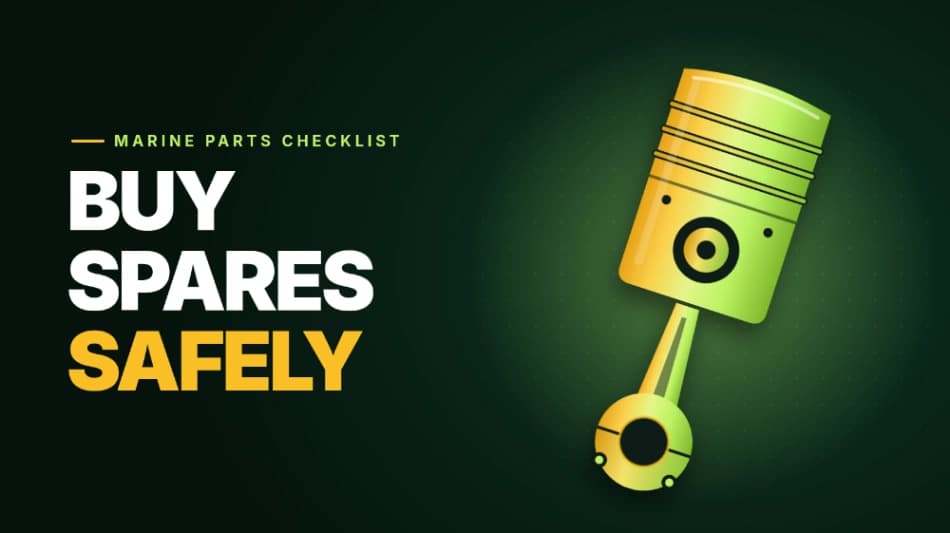
A wrong or fake part costs more than the part itself. It can stall a vessel, fail a port state inspection or damage an engine. Buying marine spares online is fast, and speed is where mistakes creep in. This checklist shows what to confirm before you pay, whether you are buying a gasket set, a generator or a used engine.
Know exactly what you need
Never buy on a description alone. Before you search, collect:
- The engine or equipment make, model and serial number.
- The part number from the manual, and a check with the maker that it has not been superseded.
- Photos of the old part and any nameplate or markings.
- Your class and flag requirements, if the part is safety-critical.
If you cannot match the part number, ask the equipment maker or your technical superintendent to confirm it. A near match is not a match.
OEM, aftermarket or used?
Wärtsilä, an engine maker, points out that not every part labelled "OEM" is genuine, and that some suppliers use a manufacturer's name without being an authorised reseller. Its advice is simple: if you have doubts, contact the equipment builder. That is one manufacturer's view, but the habit is sound for any brand.
Aftermarket and used parts can be legitimate. They need more proof. For used or reconditioned machinery, ask for running hours, overhaul records and any test reports, and have a surveyor or engineer inspect critical items.
Check the seller before the part
- Ask whether the seller is an authorised distributor, then confirm it with the manufacturer directly.
- Ask for a company name, address and trade references you can check.
- Treat pressure to pay quickly as a warning sign.
On ShipMarketSquare, listings are reviewed before they go live, which typically takes up to 24 hours. Sellers can also upgrade through Become a Seller by verifying a phone number, which lifts the 3-listing limit on new accounts. Both steps help, but neither inspects the part. Your own checks still apply.
Check compliance before the part ships
Engine emissions: EIAPP and the Technical File
The IMO's NOx rules apply to installed marine diesel engines above 130 kW, other than those used only for emergencies. Each certified engine has an EIAPP certificate and an approved Technical File on board. The file defines the engine's NOx-critical components, settings and operating values. A Record Book of Engine Parameters logs replacements and changes.
This matters when you buy parts. DNV reports that EIAPP certification and record-keeping have resulted in several port state control detentions, and that officers may check spare parts to see whether their IMO IDs match the Technical File. Before ordering a part for an engine, ask whether it appears in the Technical File. If it is not a like-for-like replacement, ask the engine maker to confirm whether it is allowed.
Asbestos in old stock
Under SOLAS chapter II-1, new installation of materials containing asbestos has been prohibited on all ships since 1 January 2011, as the IMO explains. When buying gaskets, packing or insulation, especially old stock, ask for a written statement that the item contains no asbestos, and keep it with the delivery records.
Class requirements
Some parts need class approval or certification. Ask your class surveyor which parts on your order do, and ask the seller for matching paperwork.
Documents to ask for
Request these before payment, and check them against the part:
- A commercial invoice showing part number, quantity and country of origin.
- The manufacturer's certificate of conformity or test certificate, where one exists.
- Any material or class certificates your surveyor requires.
- Batch or serial numbers, and photos of the part and its packaging before dispatch.
- For used engines, the original EIAPP certificate and Technical File. DNV advises that these documents be handed over when ownership changes.
Check key documents with the issuer. A scanned certificate proves little by itself.
Agree delivery terms and payment
Write down who arranges transport, who pays duties, and when risk passes. The ICC's Incoterms 2020 rules standardise this. Under FOB, for example, the seller delivers the goods on board the vessel the buyer nominates at the named port, and risk passes to the buyer at that point. The buyer then arranges and pays freight. An ICC Academy article notes that for containerised goods, FCA is the more appropriate rule than FOB. Pick the term that matches how your parts will actually travel.
Avoid paying everything up front to a seller you cannot verify. Ask your bank or adviser about safer payment structures, and check export control and sanctions rules for the part and the route.
Inspect on arrival
- Compare the part to your photos, drawings and the old part.
- Check markings, part numbers, packaging and paperwork against the order.
- Keep suspect parts out of service. Contact the equipment maker before you install anything you doubt.
A 10-point checklist before you order
- Part number confirmed with the equipment maker.
- Seller authority confirmed.
- Seller identity and references checked.
- Part is in the engine's Technical File, if emission-critical.
- IMO ID marking confirmed where required.
- Asbestos-free statement for gaskets, packing and insulation.
- Certificates received and checked with the issuer.
- Photos of the part and packaging received.
- Incoterms rule, duties and payment terms agreed in writing.
- Arrival inspection plan ready.
Buy and sell spares on ShipMarketSquare
ShipMarketSquare is a marketplace for vessels, offshore rigs and spares, with one search across all three. To start, search vessel parts. Categories on the site include engines, generators, gearboxes, shafts and propellers. If you are sourcing larger equipment, you can also search offshore rigs.
Enquiries go through Contact Sales, or sales@shipmarketsquare.com. According to the help center, a ShipMarketSquare sales rep contacts the seller when a serious buyer is interested.
If you sell spares, listing is free. The same rule applies to parts as to vessels: complete specifications and honest condition help buyers decide. See 5 Things to Include in Your Vessel Listing for the approach.
FAQ
Is it safe to buy marine spare parts online?
It can be, if you check the seller, the part number and the documents before you pay. Avoid deals where you cannot verify who you are dealing with.
How can I tell if a part is genuine OEM?
Ask the equipment maker to confirm the part number and whether the seller is authorised. Check markings, packaging and certificates against the order, and verify key documents with the issuer.
Do spare parts need IMO ID numbers?
Parts listed as NOx-critical in an engine's Technical File can need IMO IDs that match the file, and port state control officers may check this. Ask the engine maker which parts on your order are covered.
Can I use used or reconditioned parts?
Often yes, with records. Ask for running hours, overhaul history and test reports. For emission-critical or class-related parts, confirm with the engine maker and your surveyor first.
Which delivery terms should I use?
It depends on the shipment. Incoterms 2020 sets out who arranges transport and bears risk. Confirm the right rule with your forwarder or adviser.
How do I list spare parts for sale on ShipMarketSquare?
Create an account, click Create, and toggle to spares instead of a vessel. Listings are reviewed before going live, typically within 24 hours. New accounts can post up to 3 listings. To post more, use Become a Seller and verify your phone number.
Browse or list at ShipMarketSquare
Need a part, or have spares to sell? Browse or list at shipmarketsquare.com. Always confirm part suitability with the equipment maker, and confirm legal, class or financial points with your surveyor, broker or adviser.
Sources
- Wärtsilä, 7 truths about OEM spare parts you wish you had known before (5 December 2023)
- IMO, Nitrogen Oxides (NOx) Regulation 13
- DNV, PSC focus on NOx Technical Files and machinery components (19 December 2024)
- IMO, Asbestos on board ships
- ICC Academy, FOB and FAS Incoterms 2020 explained (13 May 2025)
- ShipMarketSquare help center