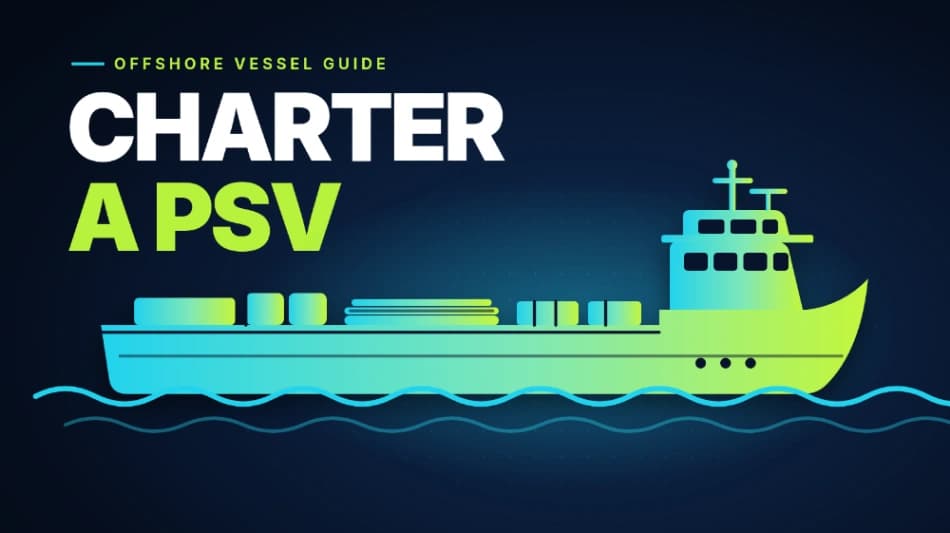
Chartering an offshore support vessel looks simple on a listing page: a type, a build year, a location. The real work sits behind those fields. The wrong vessel, the wrong DP class or a missing local licence can stop a job before it starts. This guide walks charterers, brokers and project teams through how to charter a PSV or another offshore support vessel, in the order that saves the most time.
Start with the job, not the vessel
Owners and brokers can only quote against clear requirements, so write a one-page scope first.
What to put in your scope
- The work: supply runs, anchor handling, towing, diving support, accommodation or project support.
- The cargo: deck cargo, deck area, crane needs, and any liquid or bulk cargo.
- Place and time: area of operation, delivery port, start date, duration and any options to extend.
- People: how many charterer personnel will sleep on board.
- Special tasks: ROV work, use as a diving platform, helideck, gangway or crane operations.
Match the vessel type to the work
A platform supply vessel (PSV) carries supplies to offshore installations. An anchor handling tug supply vessel (AHTS) handles anchors and towing. A diving support vessel supports diving work. A multipurpose platform supply vessel (MPSV) adds other roles to supply duty, and the mix differs from design to design, so read the specification instead of trusting the label.
Check DP class before you compare day rates
A day rate means little if the vessel cannot hold position safely. Dynamic positioning (DP) is graded by what happens after a failure. The IMO's guidelines (MSC.1/Circ.1580) define three equipment classes:
- Class 1: a single fault may cause loss of position or heading.
- Class 2: a single fault in any active component or system will not cause loss of position.
- Class 3: a single fault or failure will not cause loss of position. This includes the loss of everything in one watertight compartment or fire subdivision from fire or flooding.
The IMO says the class for an operation should be agreed between the vessel's company and the customer, based on a risk analysis of what a loss of position would cause. Decide it from your own risk assessment, not from a brochure.
DP documents to request
- The DPVAD: the Dynamic Positioning Verification Acceptance Document states the equipment class. The IMO model form is valid for no more than five years, and it stops being valid if the vessel changes flag.
- FMEA and proving trials: for class 2 and 3 vessels, the failure modes and effects analysis and its proving trial results should be kept on board.
- Annual DP trials report: the IMO guidelines call for an annual survey and tests. IMCA publishes a code of practice for annual DP trials programmes.
- Capability plots: the IMO guidelines expect position-keeping capability plots, including after the worst-case single failure.
The IMO recommends its 2017 guidelines for vessels built on or after 9 June 2017. Older vessels may follow the earlier MSC/Circ.645, so ask which standard applies. ShipMarketSquare listings can carry tags such as DP (1) System, DP (2) System and DP (3) System. Treat a tag as a starting point, then ask for the documents.
Vet the vessel and its operator
Before paying for an inspection, confirm the basics:
- The IMO number matches the listing, and the class society confirms class status directly. Many leading societies are members of IACS. Our buyer checklist covers the same checks: Reading a Vessel Like a Buyer.
- Statutory certificates are current, and the operator holds the safety management certification required under the IMO's ISM Code, which has been mandatory under SOLAS chapter IX since 1 July 1998.
- Request the Marine Safety Forum (MSF) PSV Template of Data. MSF describes it as a tool for brokers and owners submitting PSVs for charter, giving charterers detail on certification, crewing and general condition. MSF also publishes a PSV and AHT pre-hire inspection template for inspectors.
- Check whether the vessel has inspection reports in OCIMF's Offshore Vessel Inspection Database (OVID). OCIMF says OVID can speed up assurance checks in the chartering process.
Know what the charter party covers
Offshore support vessels are often chartered on BIMCO's SUPPLYTIME 2017, a time charter party that runs on a knock-for-knock liability regime. Each side bears loss of its own property and injury to its own people, regardless of fault.
Part I of the form is where the commercial deal lives. Settle these early: delivery and cancelling dates, delivery and redelivery place, period of hire and options, mobilisation and demobilisation fees, area of operation, permitted services, ROV and diving use, fuel, and the hire rate and currency.
BIMCO notes SUPPLYTIME is often used for tasks beyond its original design, and offers optional annexes for DP, crane operations, walk to work, helicopter and helideck operations, extended offshore support, crew qualifications and charterers' personnel. BIMCO also says these annexes are not one size fits all and may need amending. Have an experienced broker or maritime lawyer review the final wording. This guide is not legal advice.
Check local rules in West Africa
Local rules can decide whether a vessel can work at all. In Nigeria, NIMASA says the Cabotage Act 2003 aims to reserve commercial transport of goods and services in Nigerian coastal and inland waters to Nigerian-flag vessels owned by Nigerian citizens.
The Ministry of Transportation's cabotage guidelines (revised 2007) say the regime covers carriage linked to offshore exploration and exploitation. They list offshore service vessels, tugs, anchor handling tug supply vessels and barges among cabotage vessels. They describe a licence for foreign-flagged vessels, waivers for ownership, crewing or build requirements, and a 2% surcharge that charterers must deduct at source from charter invoices.
Under SUPPLYTIME, the charterers obtain the permissions and licences for the vessel to enter, work in and leave the area of operation, and the owners assist reasonably. These rules may have changed since 2007, and other countries have their own. Confirm the current position with NIMASA or local counsel before fixing a vessel.
A simple process from enquiry to fixture
- Write the one-page scope.
- Shortlist vessels that match type, DP class and location.
- Ask each owner for the Template of Data, DPVAD and recent inspection reports.
- Check class, flag and certificates at source.
- Run a pre-hire inspection.
- Check licences and local content rules for the area of operation.
- Agree the SUPPLYTIME boxes and annexes, then sign.
Find offshore support vessels on ShipMarketSquare
ShipMarketSquare is a marketplace for vessels, offshore rigs and spares, with one search across all three. To start, search vessels for charter. Vessel types include PSV, MPSV, AHTS, AHT, tugboats, workboats, diving support vessels and barges. You can filter by availability, vessel type, build year, country, tags and price range.
Listing pages can show type, location, build year, bollard pull, class society and flag, plus an "Available until" date. Enquiries go through Contact Sales, or sales@shipmarketsquare.com.
Owners can list for free. Listings are reviewed before they go live, which typically takes up to 24 hours, according to the ShipMarketSquare help center. For tips on writing a listing that answers charterers' questions, read 5 Things to Include in Your Vessel Listing.
FAQ
What is a PSV?
A PSV, or platform supply vessel, carries supplies and cargo to offshore installations. Check each vessel's deck area, cargo capacity and accommodation against your scope.
Which DP class do I need?
It depends on the consequence of losing position during your job. The IMO says the class should be agreed between the company and the customer based on a risk analysis. Confirm the class with the vessel's DPVAD.
Which charter party is used for offshore support vessels?
BIMCO's SUPPLYTIME 2017 is the standard time charter party for offshore support vessels. Parties often add annexes or special clauses for their project.
What should an owner send before I charter?
Ask for the MSF PSV Template of Data, the DPVAD, the latest annual DP trials report, class and statutory certificates, recent inspection reports and the class dry-docking schedule. Then verify key items with the issuer.
Can I charter a foreign vessel for work in Nigerian waters?
Possibly, but cabotage rules apply to work in Nigerian waters. NIMASA's guidelines describe licences and waivers for foreign vessels. Confirm the current rules with NIMASA or a Nigerian maritime adviser first.
Can I list my vessel for charter on ShipMarketSquare?
Yes. Creating a listing is free. New accounts can post up to 3 listings. To post more, use Become a Seller and verify your phone number.
Browse or list at ShipMarketSquare
Need an offshore support vessel, or have one available? Browse or list at shipmarketsquare.com. Always confirm vessel details with a surveyor, broker or maritime adviser before you commit.
Sources
- IMO MSC.1/Circ.1580, Guidelines for vessels and units with dynamic positioning systems (16 June 2017)
- BIMCO, SUPPLYTIME 2017
- BIMCO, SUPPLYTIME 2017 Special Tasks Annexes
- BIMCO SUPPLYTIME 2017 sample copy
- Marine Safety Forum, PSV Template of Data Form
- Marine Safety Forum, PSV and AHT Pre-Hire Inspection Template
- OCIMF, Offshore Vessel Inspection Database (OVID)
- IMCA, Code of practice for developing and conducting DP annual trials programmes
- IMO, The International Safety Management (ISM) Code
- IACS, members
- NIMASA, Cabotage Services
- Federal Ministry of Transportation, Guidelines on Implementation of the Coastal and Inland Shipping (Cabotage) Act 2003, revised 2007 (hosted by NIMASA)